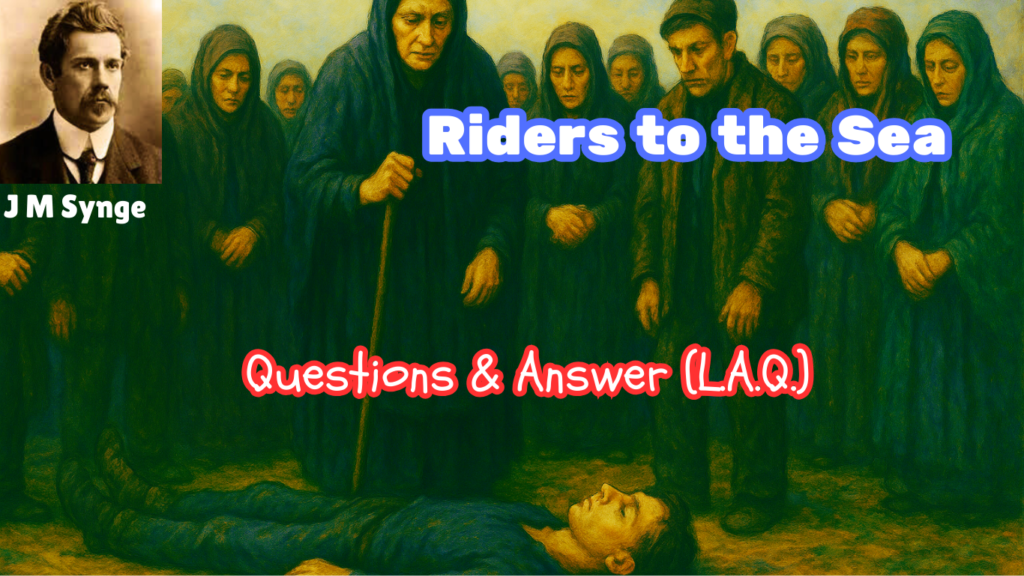
1) Analyse the character of Maurya. (5)
Ans. Maurya is the tragic, central figure of JM Synge’s one-act play ‘Riders to the Sea’. She is an old, poverty-stricken island woman who has suffered immense loss and sorrow. The sea has already taken away her husband, her father-in-law and five sons. Maurya is a loving and caring mother. Her constant anxiety for her last surviving son, Bartley, shows her maternal concern. She tries desperately to dissuade Barley from going to the sea. She is a religious and superstitious woman. Her vision of Michael riding behind Bartley protends Burtley’s death. After Burtley’s death, she reaches a state of calm acceptance, “there isn’t anything more the sea can do to him”. Thus, Maurya emerges as a powerful tragic figure of suffering, patience and resilience.
2) Role of the sea in the play ‘Riders to the Sea’. (5)
Ans. The sea plays a central role in the play, Riders to the Sea. It is the main source of livelihood for the islanders, and at the same time it is a ruthless destroyer, as it takes away the lives of Mourya’s husband, father-in-law and sons, and ultimately claims Bartley. It plays a symbolic role too. It represents the uncontrollable power of nature – wild and dangerous. It also shows that human beings are helpless in front of nature. Thus, the sea plays the role of destiny that governs the lives and deaths of islanders.
3) Sketch the character of Cathleen. (5)
Ans. Catherine is the elder daughter of Moriya in JM Synge’s ‘Riders to the Sea’. She plays an important supporting role. She is practical, responsible and emotionally strong. She is caring and protective. She hides Michael’s clothes from her mother to avoid her from further shock. She is deeply worried about Bartley’s safety, though she never stops him from going to the sea, as the family depends on him. Catherine is emotionally strong and mature. After Bartley’s death, she makes arrangements for his burial and consoles her mother in her final acceptance of fate. Thus, Catherine emerges as a symbol of endurance and responsibility.
4) Discuss the character of Nora. (5)
Ans. Nora is the younger daughter of Maurya in J. M. Synge’s one-act play, ‘Riders to the Sea’. Nora is gentle, sensitive and emotionally fragile. Her fear of the sea and anxiety for her brothers reflect her tender nature. She is obedient to her mother and sister. She follows Catherine’s instructions in concealing Michael’s clothes from Mourya. She depends on Cathleen for guidance that shows her lack of confidence. Though she is not a dominant character in the play, she strengthens the tragic effect of the play.
5) “The sea has taken all my sons.” – explain how this line represents the relentless power of nature in the play. Comment on the emotional impact this line has on Mourya’s character. (2+3)
Ans. The line powerfully conveys the relentless, destructive force of nature. Throughout the play, the sea appears as an uncontrollable power that dominates human life. Though it provides livelihood to the islanders, it mercilessly claims lives. The sea continues to take Maurya’s sons one after another. Human beings are helpless before nature’s will.
This line marks the culmination of Maurya’s lifelong suffering. It reflects her complete loss and despair after enduring repeated tragedies. Having lost all her sons, she attains a tragic calm and spiritual strength that the sea can take nothing more from her.
6) Discuss how Synge uses the sea as a symbol of fate, nature’s indifference and the source of inheritable loss in ‘Riders to the Sea. (5)
Ans. In J. M. Synge’s one-act play ‘Riders to the Sea’, the sea is not merely a physical setting but an active force that controls the lives of the islanders and shapes the play’s tragic action. The sea symbolises fate, nature’s indifference and a source of inevitable loss. The repeated deaths of Mourya’s family members show that human life is governed by an unavoidable destiny in the form of the sea. The sea represents nature’s indifference to human suffering. It gives the islanders their livelihood, yet it shows no mercy in taking away their lives. Finally, the sea is a constant source of inevitable loss. Mourya loses her husband, grandfather and all her sons.
7) Discuss how Maurya’s grief, resignation and acceptance of loss embody the theme of human vulnerability against invincible fate. (5)
And. Maurya’s grief is deep. She lost her husband, her father-in-law and six sons to the sea. This repeated tragic death has left her emotionally exhausted. As the play progresses, she moves towards resignation. She begins to accept what is inevitable. Her words and silence suggest that human effort and prayer are powerless against fate. Finally, she reaches a state of acceptance after Bartley’s death. Having lost all her sons, she realises that she can take nothing more from her. This acceptance does not have pain, but it transforms her pain into endurance.
You may also read: