1) What kind of poem is ‘The Greenhouse Effect’ written by Carl Dennis?
Ans. ‘The Greenhouse Effect’ is a didactic and satirical poem. The poem warns the reader about the impending danger of the greenhouse effect and the consequences of climate change. The poem is satirical too, as it shows man’s foolishness, indifference and carefree attitude towards nature.
2) “And the grain belts begin to slide closer to the poles” – What are the green belts? Why do they slide closer to the poles?
Ans: ‘The green belts’ are the large agricultural lands or regions where crops are grown in abundance.
Due to the greenhouse effect, the climate heats up. So the green belts will be shifted towards the polar regions in search of cooler temperatures.
3) Why will Plains states be abandoned?
Ans. Plain States will be abandoned because global warming will make the climate so hot and dry that no farming will be done. People will be forced to leave the Plains States to find a suitable settlement.
4) What are the ‘giant dust bowls’?
Ans. ‘Giant dust bowls’ are the plain states which turn into infertile lands of dust. Due to the greenhouse effect, the soil transforms into dusty wastelands
5) Mention the countries that are going to join the new great powers according to the poem, ‘The Greenhouse Effect,’ and why?
Ans. Greenland and Antarctica are going to join the new great powers, according to the poem ‘The Greenhouse Effect,’ because global warming will melt their sheets of ice and expose the fertile lands. The regions would be suitable for agriculture and human settlement.

6) “Even if we play them off against each other for more aid” – What does the poet mean by this line?
Ans. Due to the greenhouse effect, the coastal area will be flooded. Greenland and Antarctica, which are covered with ice sheets, will be great power centres. The poet imagines that the people who are displaced ask the countries for help. The climate refugees might take more advantage by making those island cities compete against each other.
7) Why will we still be poorer than we are now?
Ans. Climate change will destroy the resources that man has gained for ages. Anyhow, if we can survive and adjust in new regions, we will lose our wealth, land and comfort. So, we will be poorer.
8) How would life be different in the poem ‘The Greenhouse Effect’?
Ans. Life would be different because global warming will change our climate, our food production and our living places. Good tillable lands will no longer be found. They will either become arid or submerge in water. Men will die due to the scarcity of food.
9) Why will the suburbs give way to farms?
Ans. Global warming will destroy the farmlands. To meet the food scarcity, new farmlands are required. So, the suburbs that are actually used for living now have to turn into farmland.
10) What kind of people will fill the cities? What will they not afford?
And. Poor people will fill up the cities in the poem ‘The Greenhouse Effect’.
They will not afford cars.
11) What will be the means of transportation in the cities due to global warming?
Ans. The cities will be crowded with poor people, and they will not afford cars. So, their means of transportation will be walking or moving in trollies.
12) Why are streets lined with practical nut trees instead of elms or oaks?
Ans. Elms or oaks are decorative and ornamental plants. They are beautiful, but do not provide food. Affected by global warming, people will value the plants that will produce food. So they will plant the practical nut trees instead of elms or oaks.
13) ‘With vegetables crowding the front lawns.’ Why will the front lawns be crowded with vegetables?
Ans. As there will be no availability of farmland, it is very difficult to get food. So, people will not leave any space to grow their own food. The front lawns will be crowded with vegetables.
14) How will people maintain public buildings? Or. Why will people donate hours after work?
Ans. As the economy of a country becomes weakened due to global warming. The government does not have enough money to maintain the public buildings. So, the people have to come forward to save those buildings from destruction.
15) What are the works that are to be done by the citizens as free labour?
Ans. The poet imagines that when money becomes scarce to the governments, the citizens will have to do the task as free labour, like raking the lawn of the library and City Hall and tuckpointing the chimney of the Federal Building.
16) Why does the poet mention the temples in Rome?
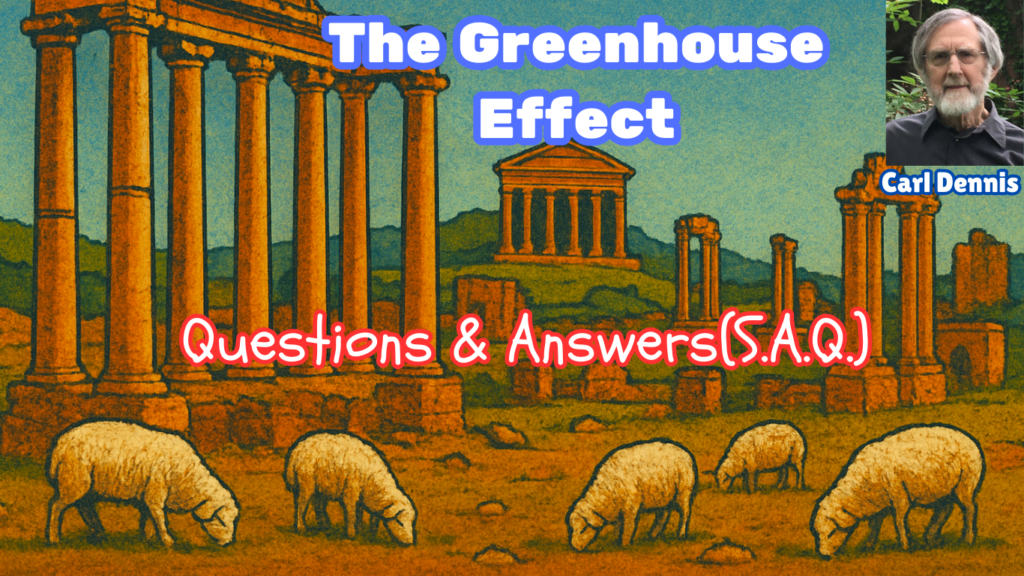
Ans. The temples in Rome were destroyed due to a lack of maintenance. The poet mentioned the temples in Rome to remind us that without proper maintenance, the public buildings will turn to ruin. So, the people should come forward to donate their free labour to restore the public building if global warming persists.
17) What does the poet mean by the line ‘don’t want sheep to graze in our squares’?
Ans. By this line, the poet means the necessity of maintaining public buildings. If they are not maintained properly, they would be destroyed like temples in Rome. They might be turned into grazing ground for cattle.
18) Why did the sheep graze in the forum for a thousand years?
Ans. After the fall of the Roman Empire, the Forum was abundant and left in ruins for years without proper maintenance. Thus, the place gradually turned into the grazing ground where the sheep move freely.
19) What are the ‘Carthages’ mentioned in the poem, ‘The Greenhouse Effect?
Ans. ‘Carthage’ was an ancient and powerful city in North Africa. It was one of the important trading hubs in ancient times. The city was destroyed by the Romans in the Punic Wars.
20) Why does Carl Dennis mention ‘Carthage’ in the poem The Greenhouse Effect?
Ans. ‘Carthage’ was an ancient City destroyed by the Romans in the Punic Wars. The poet mentioned ‘Carthage’ to show us that modern cities would also be destroyed due to human follies. So, the poet wants us to restrain ourselves to control global warming.
21) What did the poet predict about Korean armadas in the poem ‘The Greenhouse Effect’?
Ans. The poet predicted that the Korean armadas would patrol all over the world searching for new fertile land or to invade other countries to achieve success in their trading missions.
22) “Let them have their little time in the sun.” What does the poet mean by this line?
Ans. ‘Them’ here refers to the people of the modern world who are busy with enjoyment and consumption. They are totally unaware of the fact that this will be short-lived, as the greenhouse effect will destroy everything. The sun here stands for the luxurious life and comfort.
23) What does the poet mean by the phrase ‘native beach band’?
Ans. The phrase ‘native beach band’ refers to a group or band enjoying music and dancing on the beach. The phrase shows the carefree amusement of people neglecting the consequences of global warming.
24) ‘The hits from the Arctic on the radio.’ Explain the line.
Ans. The Arctic is normally a frozen and empty place. Even the Arctic is sending us messages regarding the impending danger of human civilisation caused by global warming. Still, we are indifferent.

You may also read:
The Greenhouse Effect by Carl Dennis– Questions and Answers (L.A.Q.)
The Greenhouse Effect by Carl Dennis – Summary with Bengali Meaning